Loading, please wait...
Loading, please wait...
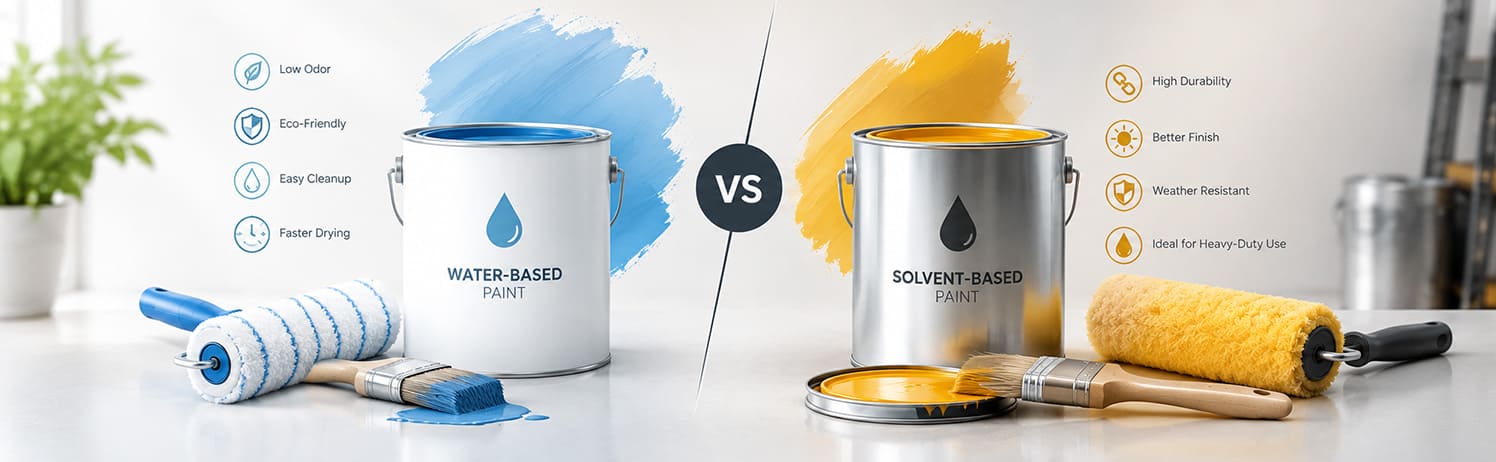
Choosing between water-based paint and solvent-based paint depends on the surface, application environment, drying requirements, durability, and coating performance required.
The main difference is the carrier used in the formulation.
Water-based paints primarily use water, while solvent-based or oil-based paints
use organic solvents. Both technologies have applications across decorative,
commercial, and industrial coating systems.
This guide explains the key differences, benefits,
limitations, and selection factors.
Water-based paint uses water as the primary carrier for
pigments, binders, and additives. Acrylic, vinyl, and latex technologies are
common examples.
As the coating dries, water evaporates, and the binder forms
a protective film on the surface.
Modern water-based paints can provide good adhesion,
colour retention, durability, and surface protection. They are widely used for
walls, ceilings, wood, metal, cladding, and many other applications.
Water-based coatings generally offer:
However, performance varies between products. A water-based
industrial coating and a standard decorative wall paint should not be
considered equivalent.
Solvent-based paint uses organic solvents to carry pigments
and binders. Mineral spirits and other formulation-specific solvents may be
used depending on the coating technology.
Solvent-based paints are often selected when a hard film,
strong adhesion, abrasion resistance, or resistance to particular chemicals is
required.
They are used on surfaces such as metal, machinery, doors,
exterior structures, equipment, and selected industrial applications.
Solvent-based coatings can provide:
The exact performance depends on the resin, pigments,
additives, formulation, and application conditions.
|
Feature |
Water-Based Paint |
Solvent-Based Paint |
|
Primary carrier |
Water |
Organic solvent |
|
Odour |
Generally lower |
Generally stronger |
|
Drying |
Often faster |
Often slower |
|
Cleaning |
Usually water for suitable products |
Usually specified solvent/cleaner |
|
VOC |
Often lower |
Often higher |
|
Finish |
Smooth and flexible |
Hard and durable |
|
Common applications |
Interior, decorative and selected industrial uses |
Metal, exterior and industrial applications |
These are general comparisons. Product formulations can vary
significantly, so technical data sheets should be checked before selecting a
coating.
Solvent-based paint may be considered when the application
requires properties that a particular water-based product cannot provide.
Cold environments can also affect water-based coatings
because water evaporation and film formation are influenced by temperature and
humidity. However, the minimum application temperature is product-specific.
For industrial applications, always follow the
manufacturer's recommended temperature, humidity, surface preparation, and
curing conditions.
Advances in coating technology have improved the performance
of water-based formulations.
Many modern water-based coatings provide good durability
while offering lower odour and easier cleanup compared with traditional
solvent-based alternatives.
They can be suitable for interior environments and
applications where VOC reduction is an important consideration.
Check the Product Label
Look for terms such as water-based, acrylic, latex,
solvent-based, alkyd, or oil-based.
The label should also provide information about recommended
surfaces, application methods, drying time, and cleanup.
The technical data sheet is more reliable than judging paint
by appearance alone. It can provide information about:
The Safety Data Sheet should also be reviewed for handling,
storage, ventilation, and personal protection requirements.
Many water-based products can be cleaned from tools using
water, while solvent-based products may require a specified solvent or cleaner.
This is only a general indication because hybrid and
specialised coating technologies can behave differently.
Water-based and solvent-based paints should not be mixed
unless the manufacturer specifically states that the products are compatible.
Their different chemical compositions can cause separation,
poor adhesion, inconsistent drying, cracking, or other coating failures.
Instead, follow the recommended primer, intermediate coat,
and topcoat system specified by the coating manufacturer.
The terms are often used interchangeably, but are not
necessarily technically the same.
Traditional oil-based paints use oils or oil-modified
binders, while the broader term solvent-based paint refers to coatings
where an organic solvent is the primary carrier.
Modern formulations can use different resin technologies, so
the product's technical documentation should be checked.
Pigments do more than provide colour. They can contribute to
opacity, appearance, durability, UV resistance, and selected protective
properties.
Voxco develops pigment solutions for coating applications,
with technical considerations including colour strength, dispersion, heat
stability, weather resistance, and application requirements.
Selecting the right pigment and binder system is important
when developing coatings for demanding environments.
There is no single paint technology that is best for every
application.
Consider:
For commercial and industrial applications, coating
selection should be based on technical specifications rather than price alone.
Both water-based and solvent-based paints have important
roles in modern coating systems. Water-based paint can offer lower
odour, easier cleanup, and lower VOC emissions in many formulations, while solvent-based
paint can provide hard, durable films for selected demanding applications.
At Voxco, understanding the interaction between pigments,
binders, additives, and coating technology is central to supporting
performance-focused paint formulations. The final product choice should always
be based on the application requirements and manufacturer's technical
documentation.
September, 2026

September, 2026

VOXCO Pigments and Chemical Pvt. Ltd. is a leading manufacturer and supplier of high-performance organic and inorganic pigments. We deliver consistent, durable, and application-specific color solutions to both domestic and international markets.