Loading, please wait...
Loading, please wait...
Choosing the right paint requires more than just choosing a
colour or finish. The type of solvent used in the paint also affects drying
time, odour, durability, cleaning, safety, and environmental impact.
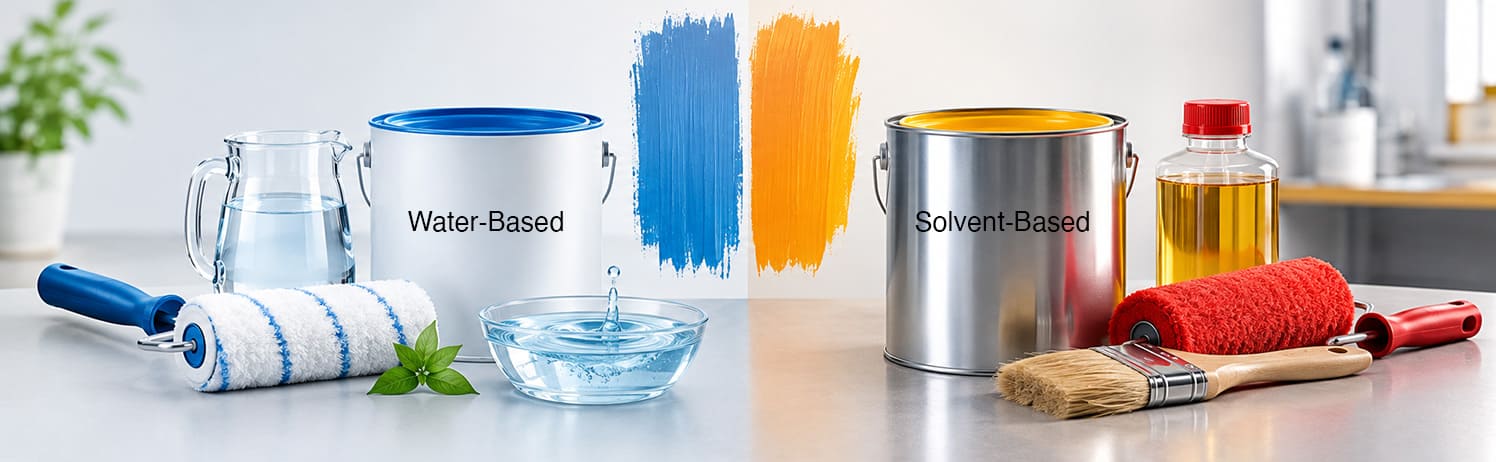
Paints are mainly divided into two categories: water-based
paints and solvent-based paints. Water-based paints use water as the
primary carrier, while solvent-based paints use organic solvents such as
mineral spirits or other hydrocarbon-based materials.
Understanding the difference can help property owners,
painters, and industrial users select the right coating for a specific
application.
Water-based paints use water as the main carrier for
pigments, binders, and other coating ingredients. As the water evaporates, the
binder forms a continuous film on the surface.
Modern water-based paints are available in acrylic, latex,
and other advanced formulations. They are widely used for interior walls,
ceilings, wood, metal, roofing, cladding, and selected industrial applications.
Water-based paints offer several practical benefits:
Many water-based coatings can be recoated within a few
hours, depending on humidity, temperature, ventilation, and product
specifications.
Water-based paints may not be suitable for every
environment. Some formulations require controlled application conditions and
may perform poorly when applied to damp surfaces or during very cold weather.
Their resistance to chemicals, abrasion, or prolonged water
exposure depends on the resin technology and product grade. Therefore, a
standard wall paint should not be used for demanding industrial applications
without technical confirmation.
Solvent-based paints use organic solvents to carry the
binder and pigments. Common solvents include mineral spirits, xylene, and other
formulation-specific materials.
These paints are known for forming hard, durable films. They
are often selected for metal surfaces, machinery, industrial equipment,
exterior structures, and applications requiring strong resistance to abrasion
or harsh conditions.
Solvent-based paints can provide:
They can also help hide minor surface imperfections.
However, proper surface preparation is still necessary for long-term coating
performance.
Solvent-based paints generally produce stronger odours and
may release higher levels of VOCs during application. Poor ventilation can
increase exposure risks, so users should follow the product safety data sheet
and use suitable protective equipment.
These coatings may also require longer drying times and
solvent-based cleaners. Disposal of leftover paint and cleaning materials must
be handled responsibly.
|
Factor |
Water-Based Paints |
Solvent-Based Paints |
|
Main carrier |
Water |
Organic solvent |
|
Odour |
Usually, lower |
Usually, stronger |
|
Drying time |
Often faster |
Often slower |
|
Cleaning |
Soap and water for many products |
Solvent-based cleaners |
|
VOC level |
Often lower, depending on formulation |
Often higher, depending on formulation |
|
Finish |
Flexible and smooth |
Hard and durable |
|
Common use |
Interiors, walls, ceilings, selected industrial surfaces |
Metal, machinery, exterior and industrial surfaces |
Water-based paints are often suitable for interior walls,
offices, homes, schools, and areas where low odour and easy cleaning are
important.
Solvent-based paints may be more suitable for heavy-duty
surfaces that require hardness, abrasion resistance, or chemical resistance.
The final choice should depend on the substrate, exposure conditions, expected
service life, and manufacturer's technical guidance.
At Voxco, coating performance is understood through the
relationship between pigments, binders, solvents, surface preparation, and
application conditions. Pigments influence colour, opacity, durability, and
selected protective properties, while the binder controls film formation and
adhesion.
A coating specialist should review the technical data sheet,
safety data sheet, recommended dry film thickness, curing conditions, and
compatibility requirements before application.
The difference between water-based paints and solvent-based
paints lies in the carrier used to make the paint. Water-based paints generally
offer lower odour, easier cleaning, and faster drying. Solvent-based paints can
provide hard, durable films for demanding applications.
Neither type is suitable for every surface. The correct
choice depends on the environment, performance requirements, safety conditions,
and technical specifications of the coating system.
October, 2026
September, 2026
September, 2026

VOXCO Pigments and Chemical Pvt. Ltd. is a leading manufacturer and supplier of high-performance organic and inorganic pigments. We deliver consistent, durable, and application-specific color solutions to both domestic and international markets.